
 Facebook
 X
X
 Pinterest
 Copy Link
Top 5 "Smart" Reasons To Live in Bellevue, Washington

Downtown Bellevue
Bellevue, Washington is a “smart” city in more ways than one. Three articles from vastly different sources gave “smart” reasons to live in Bellevue. The Northwest Asian Weekly, highlighted many of the reasons the Asian community has flocked to the city of Bellevue in recent years.
US News and World Report announced its list of top schools in the nation today. Several Bellevue Schools made the list.
Lastly, an article in the NRDC, The National Resource Defense Council, Smarter Cities blog commended Bellevue for its use of hydro-power as part of Washington State’s “Shrink Your Carbon Footprint.”
Bellevue is a “smart” place to live because of:
- The quality of life
- Education
- Economic growth
- Prosperity
- A good balance with a strong business climate combined with “smarter” energy sources
The Northwest Asian Weekly had some great quotes, which sum up many of the most important reasons why Bellevue has become a “smart” place to live. The reasons it is a great place, a smart place, make Bellevue a great place to live for everyone.
The Quality of Life:
Bellevue’s prosperity has attracted Asians from other countries and from surrounding cities. The corporate job opportunities, low-crime rate, city facilities and services, high-ranking school district, low property taxes, and appreciating real estate values in Bellevue satisfy the criteria that many immigrants look for in finding a place that represents what they feel America has to offer, as well as a place where their children can thrive.
Education:
The higher influx of immigrants is also reflected in Bellevue’s school district where Asian languages are among the top 10 languages spoken among the student body. Immigrants valuing college education for their children cite the quality of the schools as one of the main reasons for moving to Bellevue. In 2009, five Bellevue high schools — International, Interlake, Newport, Sammamish, and Bellevue — were ranked in the top 100 public schools in the nation by Newsweek.
Today, US News and World Report published its list of the top schools in the country. Other high schools in King County made the list, but Bellevue had four schools honored:
- The International School: # 10 out of the top 100 Gold.
- Newport High: #72 out of 100 Gold.
- Bellevue High: #78 out of 100 Gold.
- Interlake High: Silver medal
The economic climate:
“Bellevue is now home to the headquarters of many small and large businesses, many of which are technology companies that started in the 1990s and are still growing with their global presence,” said Debadutta Dash, co-chair of Washington State India Trade Relations Action Committee.
“Perhaps nowhere else than in the Bellevue area could you find such a high concentration of individuals and businesses with international connections,” said HSBC Bank Vice President-Manager Victor Melnik.
Prosperity:
Based on per capita income, Bellevue is ranked as the 15th wealthiest of the 522 communities in Washington.
The NRDC blog Smarter Cities blog highlights Bellevue as a city which is part of the Washington State’s plan to shrink carbon emissions through hydro-power. Bellevue achieves its growth as a burgeoning economic center while balancing its carbon footprint. In addition, Bellevue has lots of green with 90 parks and many walking trails.
Why do you think Bellevue is a “smart” place to live?
The First Big Decline in Homes for Sale in King County Washington
Twelve days ago I wrote a post that King County properties for sale was rapidly heading up to the 2009 high. Just last week we were within 300+ homes/condos of the 2009 peak, which stands at 13,861. There 13,515 homes/condos for sale in King County that week.
This week we see the first big decline, with a drop of 570 properties. The number is back below 13,000, at 12, 946.
Phew, I was just beginning to wonder if we were going to surpass 2009’s real estate totals in the Seattle area. We may, as 2010 is still young, but it’s a breath of fresh air in the real estate market to see a drop in inventory (the number of homes and condos for sale). Sales have been brisk as many buyers were anxious to buy a home in the Seattle area before the expiration of the 2010 tax credit, which could explain the decline in inventory.
The next few weeks will be interesting. Normally the number of homes for sale does increase in the summer months in Seattle, but I’m wondering if a lot of sellers put their home on the market earlier this year to capture the activity with the 2010 home buyers’ credit.
Do you think the numbers will increase as we head into the summer?

King County Washington Properties for Sale, 5-3-10
Make More Money Selling Your Home, Part 4, Dress Up the Front Door
You’re a home buyer out looking at homes. You pull in front of a home that looks kind of interesting. You stand by the front door as your agent gets the key out of the key box to open the door. You look around the entrance and notice dirt and scuff marks on the front door. The brass plate is all tarnished, there are scratches by the key hole and the door mat is dirty. It looks like there’s been years of wear and tear and you haven’t even been inside.
A dirty front door and scratched hardware is not a big deal, or is it?
Buyers, what do you think?

Tarnished front door handle

Scratched front door key hole
I heard from past buyers that it raises a lot of questions. Mostly, the buyer is wondering how well the home has been maintained if something so obvious sticks out when you first walk up. Will this buyer be taking a closer look at the house? Will the buyer start wondering if there might be maintenance issues. Possibly.
A nice front door and shiny hardware make a big difference. It keeps the level of positive energy and interest up. It’s like seeing a blind date for the first time, you want that person to look good from the “get go,” not with messy hair or dirty clothing.

A Beautiful Front Door Creates a Great First Impression

Flowers By The Front Door Add a Nice Touch
So home sellers, stand out in front of your home by the front door, just as a buyer would. Look at what the buyer would be looking at when standing at the front of your home.
- Is your front door dirty?
- Is it in need of paint?
- Is the hardware gleaming and fresh or is it scratched?
- Are the railings in good shape?
- Are the steps neat and clean?
- Do you have flowers providing color by the front door?
- Is the doormat, fresh and clean?
- Do the house numbers look clean and stand out?
None of the fixes for the above should cost a lot of money. It can actually cost you more money if these items are not in good condition. Here are some more suggestions for creating that great curb appeal.
So before you sell your home, think of it like getting ready for a date or going to a party hoping to meet someone. In this case, your home is meeting a potential buyer. The buyer has a lot of options to choose from, like you might at a party. Help the buyer to choose your home by getting it ready for the party, oops, I mean to sell.
Seattle-Eastside New Condo Buildings Still Standing Half Empty
Seattle-eastside new condo buildings are standing half empty. American Public Media took a look at the Seattle and Bellevue condo market in a piece aired on NPR last week. Below are some of the key points:
Escala, here in front of us, it’s 230 units. And they’ve only sold two in the last year-and-a-half.
The over-building is visible in surrounding cities as well, like Bellevue, where the new Bellevue Towers added 550 condos to the market.
Bellevue Towers- before completion

Jeff Tyler interviewed Michael Brandt, who purchased a unit in Bellevue Towers last year.
Brandt: I’m actually not paying home owners’ dues right now, and won’t be for potentially a year-and-a-half or two years down the road.
So, the perks for condo owners now are no home owners dues or lines to use the public spaces and/or equipment and the quiet. The negatives are no representation on the home owners’ association board until 60% of the units sell, a mostly empty building, and real difficulty reselling a condo now, since there are still so many unoccupied units for sale.
Some buyers may still want to buy in one of the condo towers because the hope is to get a screaming deal. For certain buyers who plan to stay and make one of the new condos a home, then it may make sense to do so. The Bellevue-Seattle condo real estate market should come around again, But don’t buy in one of the towers if your plan is to sell anytime in the next 5 years. In fact, I’d plan to stay put for a good 10 years. Maybe the condo market will change before that time, but I’d go for a really good deal and plan to stay for a long time if I were buying a Seattle or downtown Bellevue condo.
A Little Discrimination in the 2010 Home Buyer Tax Credit?
It’s very late in the game with the 2010 home buyer tax credit, the finish line is only days away. My purpose in mentioning this issue now is so something like this doesn’t happen again. The next time Congress enacts a piece of legislation such as this, there shouldn’t be any discrimination against people because they’re newly married.
My team is working with a home buyer who just discovered he and his wife are not eligible for the 2010 home buyer tax credit. He qualifies for the repeat home buyer tax credit because he’s owned his home for more than 5 years. He married 3 years ago, so his wife does not meet the 5 year rule to qualify. She, of course, is eligible for the first time home buyer tax credit, but he is not.
Here are some questions and answers about this very issue from the National Association Of Home Builders website’s frequently asked questions. In addition, I checked out H.R. 3548, the bill that included the tax credit, (it’s in Section 11), but it really tells you nothing.
For married taxpayers, the law tests the home ownership history of both the home buyer and his/her spouse. That is, both spouses must qualify as long-time residents, with at least five years of principal residency for each.
Does a married couple qualify for any home buyer tax credit in the following situation? Spouse A has lived in and owned the same principal residence for at least five years. Spouse B has lived in and owned the same principal residence for less than five years.
In this situation, the couple does not qualify for any home buyer tax credit. Because the couple is married, the law tests the ownership history of both spouses. Spouse A clearly does not qualify for the $8,000 first-time home buyer tax credit, so neither does Spouse B.
Ironically, if they weren’t married, they could qualify:
How can two unmarried buyers allocate the tax credit if one qualifies for the $8,000 first-time home buyer tax credit and the other qualifies for the $6,500 repeat home buyer credit?
The buyers can allocate the tax credit in any reasonable manner, provided neither claims a tax credit higher than the one they qualify for and the home purchase does not yield a total of more than $8,000 in tax credits. For example, the repeat home buyer could claim $6,500 and the first-time home buyer could claim $1,500. Alternatively, both buyers could claim a $4,000 tax credit.
The language is very much the same with regard to the first time buyer tax credit:
- How can two unmarried buyers allocate the tax credit if one qualifies for the $8,000 first-time home buyer tax credit and the other qualifies for the $6,500 repeat home buyer credit?
The buyers can allocate the tax credit in any reasonable manner, provided neither claims a tax credit higher than the one they qualify for and the home purchase does not yield a total of more than $8,000 in tax credits. For example, the repeat home buyer could claim $6,500 and the first-time home buyer could claim $1,500. Alternatively, both buyers could claim a $4,000 tax credit. - Does a married couple qualify for any home buyer tax credit in the following situation? Spouse A has lived in and owned the same principal residence for at least five years. Spouse B has lived in and owned the same principal residence for less than five years. In this situation, the couple does not qualify for any home buyer tax credit. Because the couple is married, the law tests the ownership history of both spouses. Spouse A clearly does not qualify for the $8,000 first-time home buyer tax credit, so neither does Spouse B.
Spouse A does appear to qualify for the $6,500 repeat buyer credit, but because Spouse B has not owned and lived in the same principal residence for at least five years, neither of them can claim the repeat home buyer tax credit.
So, please tell elected officials not to discriminate against married, unmarried or newly married people. Everyone should have had an equal opportunity for the home buyer tax credit.
What do you think?
The Number of King County WA's Properties For Sale is Climbing
The number of properties for sale in King County Washington is climbing. The total took a big jump over the last few weeks when 783 properties came up for sale. Since January when the year started with 9726 King County properties for sale, the numbers have gone up by 28%. Right now, the total is just 452 shy of the highest number of properties on the market in 2009. The big difference in 2010 is sales activity is going strong and beating 2009 numbers by a huge margin in all areas. Some Seattle neighborhoods, like Queen Anne, are seeing multiple offers. In the area where I work, Seattle’s eastside, has had double and triple digit increases in home and condo sales.
The increasing number of listings may change that some in the coming months. I’ll be watching the real estate sales numbers and keep you posted.

King County Properties For Sale
Photos Don't Tell Everything About a House, Go See It

Professionally staged and photographed-photo by Layne Freedle, Staging by Pam of Staging for Charisma
Professional photography and staging are, without question, necessary to sell a home in today’s marketplace. We have our stager and photographer ready for our sellers when they’re needed. I wouldn’t list a home for sale without professional staging or photography.

The Same Room Unstaged and Not Professionally Photographed
There are many other good real estate agents who believe the same thing as there are a lot of blog posts about horrible house photos. This is not a new idea, but one that’s taken a strong hold among good real estate agents.
There are, of course, some homes which show beautifully and don’t need the staging, but we all know, even if we don’t admit it, staging and photography are necessary marketing tools to get a home sold.
Sometimes we forget, great staging and photography are only the start. They’re not the complete story. You’ve got to get out and see the house “in the flesh.” This advice, by the way, is both for Realtors and home buyers. You can’t do an effective market analysis as a real estate agent or fall in love with a house as a home buyer unless you see it, smell it, and hear what’s going on in the neighborhood. You need to “touch” the house in a variety of ways to determine its true value.
I was reminded of this very thing yesterday when my business partner, Angie Bondurant, previewed a home that’s strong competition to an upcoming listing. The home looked gorgeous online, which it should in order to attract the most buyers, but two things were not apparent until Angie went to see the home. It smelled and it was dark. A smelly house, whether it’s that “old” smell, food smell, dog smell or something else, can be a total turnoff to a buyer, even if the home is gorgeous.
A dark house is the kiss of death in Seattle. Of course, it rains 24/7 here as the world thinks, so light, airy homes are popular. (In reality, there are a lot of gray days in Seattle, but it doesn’t rain all the time by any means) A bright home is always a plus in this climate.
This home ended up with two strikes against it, both of which had to be experienced by seeing the home. It was dark and smelly. Granted it was finished beautifully and this will help it to sell, but the other factors may limit it’s market time and final sales price.
So besides the amount of light and odors, other things to consider that aren’t apparent when you see photos online:
- How loud are the neighbors? Come visit the neighborhood a few random times.
- How loud is road noise with or without the windows open? Stop by during rush hour.
- How big are the rooms, really? Wide angle lens accentuate room sizes in photos.
- Check out the backyard for its true size.
- What do you see from each of the home’s windows? From the backyard?
What else should be experienced when viewing a home?
Make More Money Selling Your Home, Part 3, Clean Up Your Yard
Want to Make the Most Money Selling Your Home? Clean up your yard. I spoke about planting flowers previously, now I’ll talk about having your yard looking good.

Unsightly looking lawn hurts a home sale.
You’ve heard of a “bad dye job”? This is a bad lawn job. This lawn exists in front of home for sale, a home that has a sign in front of it! Seriously.
If you were a buyer, what would you think? Would this lawn make you question how well the home is maintained? Would you question whether the owners cared for their home? It leaves a terrible impression.

A green lawn that's ready to go
This is the front yard of another home. The yard is not fancy, but it looks well taken care of, creating a nice first impression. It doesn’t raise any red flags about maintenance, but instead helps a buyer focus positively on the home, rather than creating a negative feeling from the “get go.” Help buyers get out of their car to see your home. Make them want to come inside, not drive away.

A yard should not look like this when selling a home
The yard above should look more like the one below. Some homeowners neglect the little back corners of a yard. There can be some simple, inexpensive fixes, which make the corners of the yard look neat and organized. Gravel, bark, and some edging, whether it’s bricks or stones or something else, give it a finished, neat feel. None of these materials cost a lot of money. They can be somewhat labor intensive, so the choice would be to pay for it and do it yourself or hire someone to do it for you. It would depend on your budget, time, and energy. If you’re a do-it-yourselfer, this video form the DIY network gives some basic tips for ‘greening” your lawn.

A Nicely Organized Corner of the Yard
Regardless, you need to clean up your yard to make the most “green” when selling your home.
What Were The Odds of Selling Your Seattle-Eastside Condo in March, 2010?
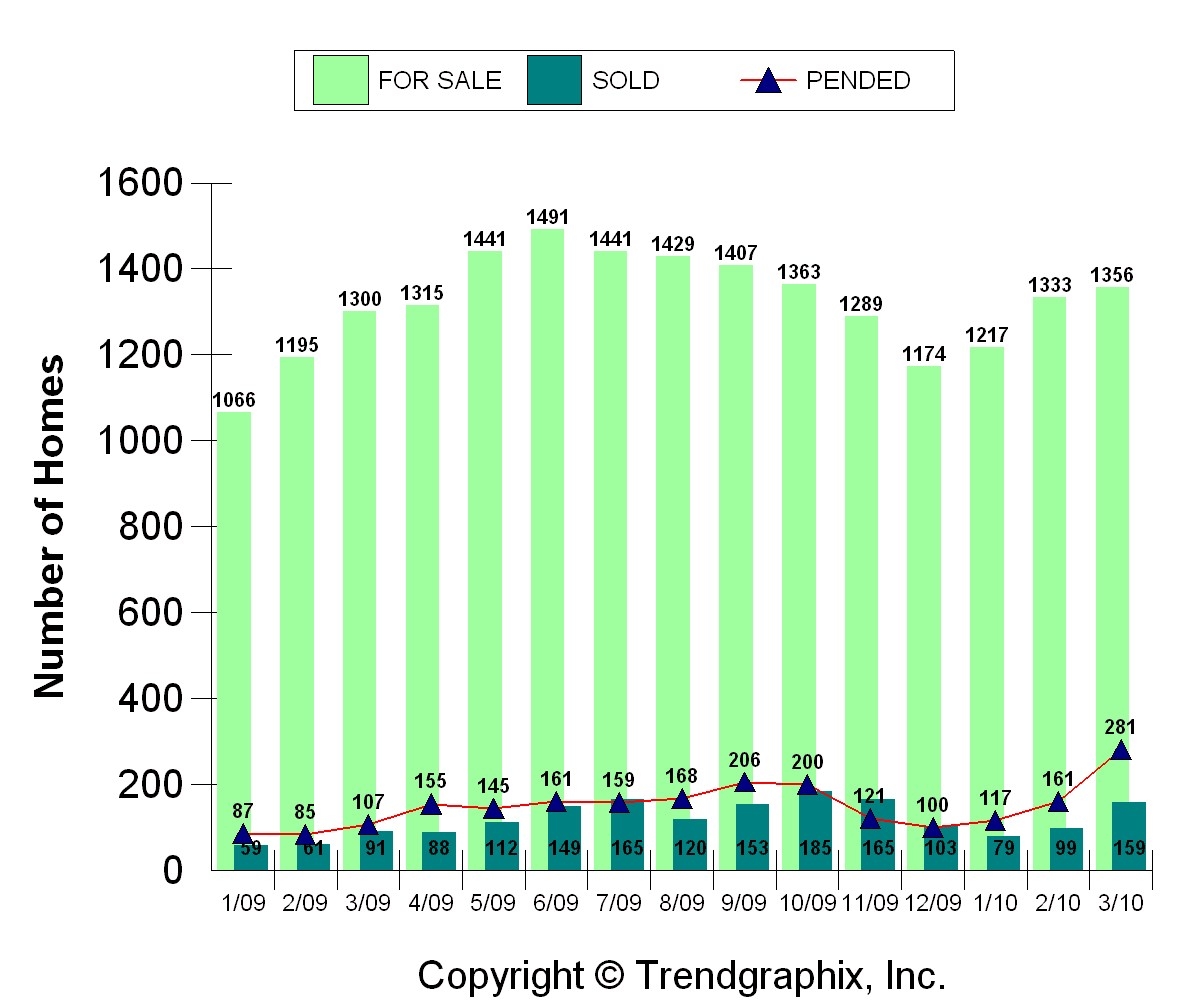
Seattle-Eastside Condo Sales, March 2010
(The absorption rate, the percentage of condos selling, is the number of condos for sale in any given month divided by the actual number of condos sold that month. So if the absorption rate or chance of selling is 10% that means out of 100 condos for sale, 10 received offers and sold.)
March, 2010 1356 condos for sale, 281 condos sold, 21% odds of selling.
February, 2009 1333 condos for sale 161 (was 194) condos sold 12 %(was 14%) odds of selling.*
March, 2009 1300 condos for sale 107 condos sold, 7% odds of selling.
*Adjusted from previous month’s original numbers to reflect the actual number of condos sold and closed. Some of the sales originally reported last month failed and did not close. Seventeen percent of condo sales originally reported in March failed to close. Some of the reasons sales fail are the buyer and seller don’t agree on the building inspection, the condo does not appraise for the sales price or the buyer’s financing does not come through.
Seattle-eastside condo sales were up by 120 or 57%, the best sales record in several years.
For The Seattle Times update on the March, 2010 real estate market, check this link.
How Did March, 2010 Home Sales Stack Up in Your Seattle-Eastside Neighborhood?
[googlemaps http://maps.google.com/maps?source=s_q&hl=en&geocode=&q=Seattle-eastside&sll=47.709762,-122.011414&sspn=0.310487,0.911865&ie=UTF8&split=1&radius=21.22&rq=1&ev=zo&hq=Seattle-eastside&hnear=&ll=47.709762,-122.011414&spn=0.310487,0.911865&t=h&output=embed&w=425&h=350]
How did March, 2009 stack up to March, 2010 in your neighborhood?
(Click on the cities below to see real estate trends for the past 5 years. You’ll find the median pricing for each city and whether the number of homes for sale and the number of sales went up or down. The odds of selling a home in each area is a result of the number of homes for sale divided by the actual number of home sales.)
The plateau: Sammamish, Issaquah, North Bend, and Fall City
The odds of selling a home were 31%.
Median sales price dropped from $513,025 to $497,500.
The number of homes for sale dropped by 22% and sales were up by 154% from last year.
The odds of selling a home were 34%.
Median sales price dropped from $499,000 to $464,995.
The number of homes for sale dropped by 12% and sales were up by 84%.
The odds of selling a home were 27%.
Median price increased to $539,450 from $519,900.
The number of homes for sale dropped by 24% and sales were up 93%.
Woodinville/Bothell/Kenmore/Duvall/North Kirkland
The odds of selling a home were 26%.
Median price decreased to $396,725 from $450,000.
The number of homes for sale declined by 18% and sales were up by 68%.
The odds of selling a home were 22%.
Median price increased to $515,000 from $490,000.
The number of homes for sale declined by 22% and sales were up by 118%.
The odds of selling a home were 18%.
Median pricing was down from $1,185,000 to $921,500.
The number of homes for sale decreased by 28% and sales increased by 24%.
Redmond/Education Hill/ Carnation
The odds of selling a home were 29%
Median pricing increased from $481,450 to $529,450.
The number of homes for sale decreased by 21% and sales increased by 18%.
When compared to March, 2009, three areas of Seattle’s eastside showed an increase in median prices including South Bellevue and Issaquah, Redmond and Carnation, and Kirkland. South Bellevue and Issaquah home prices remained steady for the third month in a row, which is the only area on the eastside to experience a consistent upswing in pricing.
The most significant decrease was in pricing was in West Bellevue, where median home values dropped by 22%. Most Seattle-eastside neighborhoods experienced a reduction in sales price.
Home sales, on the other hand, continued to be strong all over the eastside. Sales increases ranged from 18% in Redmond and Carnation to 154% on the plateau, Sammamish and Issaquah.
Twenty-one percent less homes are for sale on the eastside than last year. Although over 200 more homes are for sale than in February, which is typical for this time of year.
Seattle eastside home sales should continue to be strong through April. We’ll see what happens after that time, however, I don’t expect much to change for the higher price ranges. And nothing may change at all. We could continue to have a strong real estate market.
What’s happening in your area?
